- 01The Farm Scaling Paradox: Why Adding Printers Destroys Unprepared Margins
- 02Batch Pricing Dynamics: Setup Labor Dilution vs. Pure Machine Run Time
- 03Managing Fleet Depreciation: Calculating Shared Maintenance Pools
- 04Closing Commercial Clients: Why Executive PDF Proposals Beat Casual Text Messages
- 05Frequently Asked Questions (FAQ)
The Farm Scaling Paradox: Why Adding Printers Destroys Unprepared Margins
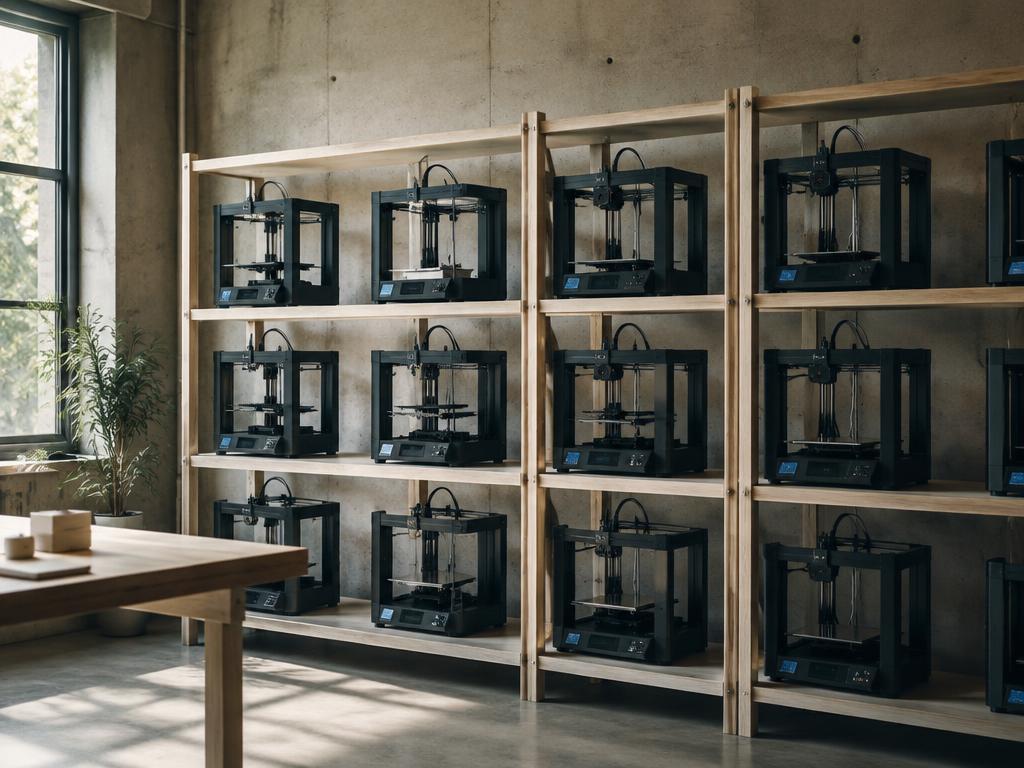
Rule of thumb: Scaling from 1 to 8 printers multiplies workshop overhead before orders arrive. An 8-printer farm offers 5,760 monthly hours; running at 45% capacity leaves 3,168 idle hours ($4,752 unrecovered). Without batch pricing, scaling turns a $300 profit into a $480 monthly deficit.
A single 3D printer running at home operates with near-zero overhead. But scaling up to 4 or 8 machines triggers inescapable fixed costs: dedicated workshop space, 20A electrical breakers, active ventilation, and filament dehumidification.
If your commercial pipeline only fills 2,000 of your 5,760 available hours, the remaining 3,760 idle hours burn capital through silent depreciation and workshop rent. You need volume batch pricing that lands corporate clients while covering base machine time.
| Operational & Financial Metric | Solo Setup (1 Printer) | Micro-Farm (4 Printers) | Commercial Farm (8 Printers) |
|---|---|---|---|
| Hardware Capital Expenditure | $900 (1 Unit) | $3,800 (4 Units + AMS/Spares) | $7,600 (8 Units + Racks/PDU) |
| Dedicated Monthly Fixed Overhead | $45 / month (Desk space) | $180 / month (Dedicated room/AC) | $420 / month (Workshop/Ventilation) |
| Available Hours @ 24/7 (30 Days) | 720 Machine Hours | 2,880 Machine Hours | 5,760 Machine Hours |
| Realistic Machine Utilization (OEE) | 75% (540 Paid Hours) | 60% (1,728 Paid Hours) | 45% (2,592 Paid Hours) |
| Unbilled Idle Capacity Deficit | 180h ($270 unrecovered) | 1,152h ($1,728 unrecovered) | 3,168h ($4,752 unrecovered) |
| Monthly Maintenance Reserve Pool | $35 / month ($0.06/h) | $190 / month ($0.11/h) | $460 / month ($0.18/h) |
| Break-Even Monthly Revenue Need | $280 / month | $1,150 / month | $2,650 / month |
| Net Profit with Casual Single Quotes | +$310 / mo (+36% margin) | +$190 / mo (+11% margin erosion) | -$480 / mo (Net Operating Deficit!) |
| Net Profit with InfillQuote Batch Engine | +$340 / mo (+38% margin) | +$920 / mo (+42% protected margin) | +$2,240 / mo (+44% optimized margin) |
Table: Fleet Economics Audit: 1 vs. 4 vs. 8 Printers (Bambu Lab P1S / X1C / Prusa MK4S Farm Benchmarks)
Note: Simulated for high-speed enclosed CoreXY machines running PLA/PETG ($24/kg) with an operator billing rate of $35/h and $0.16/kWh grid power.
Batch Pricing Dynamics: Setup Labor Dilution vs. Pure Machine Run Time
Rule of thumb: Never discount filament or machine hourly rates. Setting up a job takes 30 minutes ($15.00). On a 1-off print, setup adds $15.00/unit; in a 50-piece batch, it dilutes to just $0.30/unit. Pass on setup savings, not your profit margin.
The #1 mistake print farms make is giving flat 30% or 40% discounts on large orders. Cutting prices across the board chops straight into raw filament and machine wear—two costs that never shrink per unit.
Instead, separate fixed preparation labor (CAD inspection, slicing, bed prep) from variable runtime. A $15.00 prep cost divided by 50 units drops to $0.30 per piece, giving customers compelling bulk rates while your workshop pockets more total cash.
FXTechnical Breakdown · How InfillQuote calculates this behind the scenes (View formula)▼
Cost_{unit}(Q) = M_{unit} + (T_{unit} \times R_{machine}) + \frac{T_{setup} \times R_{labor}}{Q} + \frac{Overhead_{fixed}}{Q}Where Q is total batch quantity, M_unit is direct polymer and purge mass, T_unit is machine runtime per item, and T_setup * R_labor is fixed pre-flight setup labor strictly diluted across Q units.
- Pre-Flight CAD Inspection: Verify wall thicknesses, draft angles, and hole tolerances before committing fleet capacity.
- Plate Nesting Optimization: Group identical parts on the same plate to minimize operator bed swaps and prime tower overhead.
- Floor-Price Protection: Never discount below Direct Material + Machine Hourly Rate + Target Net Margin, no matter how large the client order.
Managing Fleet Depreciation: Calculating Shared Maintenance Pools
Rule of thumb: 8 printers running 4,000 hours/year destroy 15+ hardened nozzles, 10 PEI plates, and belts. Add a $0.25 to $0.40/hour maintenance buffer into every quote to keep emergency spares on your shelf and prevent costly shop downtime.
A clogged nozzle on a hobby printer is an inconvenience. On an 8-printer farm with tight B2B deadlines, a broken machine risks late delivery penalties, angry clients, and stalled revenue.
Build a dedicated fleet maintenance reserve. By baking $0.25 to $0.40 into every billed machine hour, your workshop automatically finances replacement nozzles, extruder gears, belts, and PEI sheets before they break.
FXTechnical Breakdown · How InfillQuote calculates this behind the scenes (View formula)▼
R_{fleet\_maint} = \sum_{m=1}^{N_{printers}} [ \frac{Annual\ Spare\ Parts\ Budget_m ($)}{Annual\ Planned\ Operating\ Hours_m} + \frac{Machine\ Acquisition\ Cost_m ($)}{Useful\ Lifespan\ Hours_m} ]Calculates the consolidated hourly fleet amortization reserve, ensuring hardware renewals and consumable replacements (nozzles, sheets, belts, lubricant) are self-funding.
- Shelf-Ready Spares Inventory: Maintain at least 2 complete pre-assembled hotends, 2 replacement PEI sheets, and 1 spare extruder on hand per 4 machines.
- Preventative Service Calendar: Schedule bi-weekly linear rod lubrication, belt tension checks, and hotend thermal paste renewal.
- Standardized Hardware: Standardizing your entire farm on identical machine models slashes spare parts inventory costs by 60% compared to mixed fleets.
Closing Commercial Clients: Why Executive PDF Proposals Beat Casual Text Messages
Rule of thumb: Corporate procurement and engineering teams immediately reject informal chat estimates. Sending an executive PDF proposal with technical tolerances (±0.2mm), material specs, and quantity tiers commands premium rates and 40%+ margins.
Amateur makers pitch corporate clients with informal messages like "I can do 50 of these for $8 each." Corporate finance cannot cut purchase orders on informal messages, and engineers assume the workshop lacks dimensional discipline.
InfillQuote PDF proposals supply everything corporate buyers need: formal headers, quote numbers, polymer test specs, standard tolerances, and tiered batch pricing. You stop competing with bedroom hobbyists and start winning corporate contracts.
- Technical Material Datasheets (TDS): Include polymer specifications (such as PETG, PA-CF, or ABS thermal limits) to validate engineering suitability.
- Explicit Dimensional Tolerances: State achievable FDM tolerances (typically ±0.2mm or ±0.5%) to prevent frivolous customer rejections.
- Structured Commercial Payment Terms: Require 50% deposit upon order confirmation and 50% prior to dispatch for first-time commercial clients.
- Serialized Invoicing & Traceability: Track quotes with dedicated numbering and expiration dates to protect your workshop against raw resin price volatility.
Frequently Asked Questions
What is a safe wholesale quantity discount curve for 3D print batches?
A safe volume discount curve should never discount raw material costs or baseline machine hourly rates. The discount must be derived solely from the mathematical dilution of setup labor and bulk material purchasing advantages. For standard production batches: 1-9 units: List Price (100%); 10-24 units: 10%–12% discount; 25-49 units: 18%–22% discount; 50-99 units: 25%–30% discount; 100+ units: Max 35% discount, provided net profit margin remains above 30%.
How do I calculate the true financial cost of idle printer capacity?
An idle printer is not free. To calculate idle machine cost: add monthly equipment capital financing (or depreciation allocated per month) plus facility rent and floor allocation per machine, divided by 720 available monthly hours. For an $800 printer in a $300/mo workshop space, an idle machine costs approximately $0.45 to $0.75 for every single hour it sits unpowered without producing revenue.
Should a commercial print farm standardize on one printer model or use a mixed fleet?
Standardizing on a single machine ecosystem (e.g., all Bambu Lab P1S/X1C or all Prusa MK4S) is vastly superior for farms scaling from 1 to 8 printers. Standardized fleets share identical slicer profiles, consume the same spare nozzles, heater blocks, and build plates, and allow any pending print job to be routed instantly to any open machine without file re-slicing or tolerance variations.